Nigeria Wheat Import Prices: Global Shocks Amplified by Local Pressures
Nigeria’s wheat import market has experienced significant price volatility over the past seven years, reflecting a combination of global wheat supply disruptions and domestic macroeconomic pressures. While international weather, production, freight costs and geopolitical events have been the primary drivers of global wheat prices, their impact on Nigeria has been amplified by naira depreciation, foreign-exchange constraints and import-policy uncertainty.
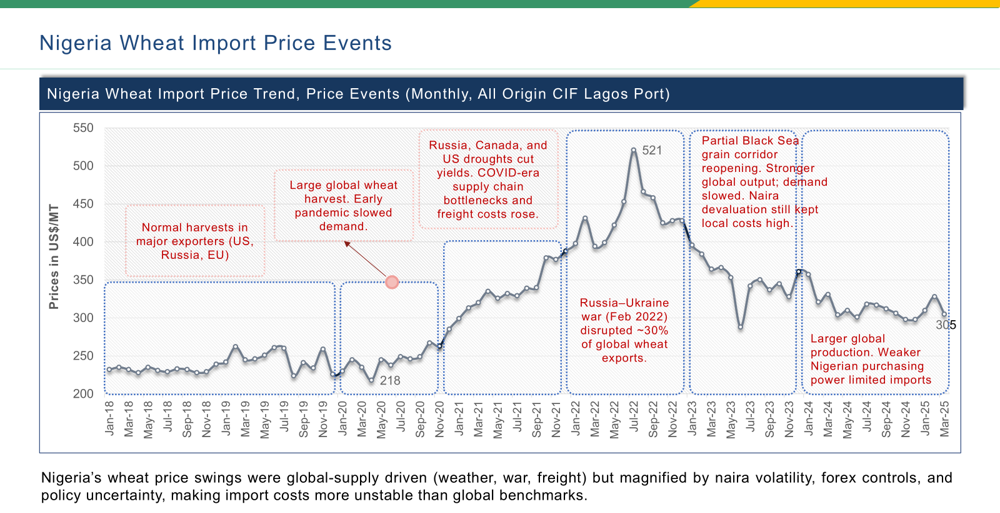
Nigeria’s wheat import prices have been highly volatile, driven primarily by global supply conditions, geopolitical disruptions, freight costs and naira movements.
From 2018 to early 2020, CIF Lagos wheat prices remained relatively stable at around US$220–260/MT, supported by normal harvests in major exporting countries.
The market changed sharply during 2020–22. COVID-19 initially weakened demand, but the subsequent global recovery created supply-chain bottlenecks and higher freight costs. The Russia–Ukraine war in 2022 triggered the largest price shock, disrupting Black Sea exports and pushing Nigeria’s import price to a peak of approximately US$521/MT.
Prices subsequently declined as the Black Sea grain corridor reopened and global wheat production improved. By 2023, prices had fallen toward US$300/MT. However, naira depreciation and foreign-exchange constraints kept Nigeria’s import costs relatively elevated despite the easing in global wheat prices.
By March 2025, the CIF Lagos price stood at around US$305/MT, substantially below the 2022 peak but still vulnerable to currency and policy-related pressures.
Key Takeaway
Nigeria’s wheat import prices are influenced by two interconnected factors:
Global wheat fundamentals + Nigerian currency/FX conditions = Landed wheat cost
Going forward, importers should closely monitor global wheat production, Black Sea exports, freight rates, the naira exchange rate and Nigeria’s foreign-exchange policies.