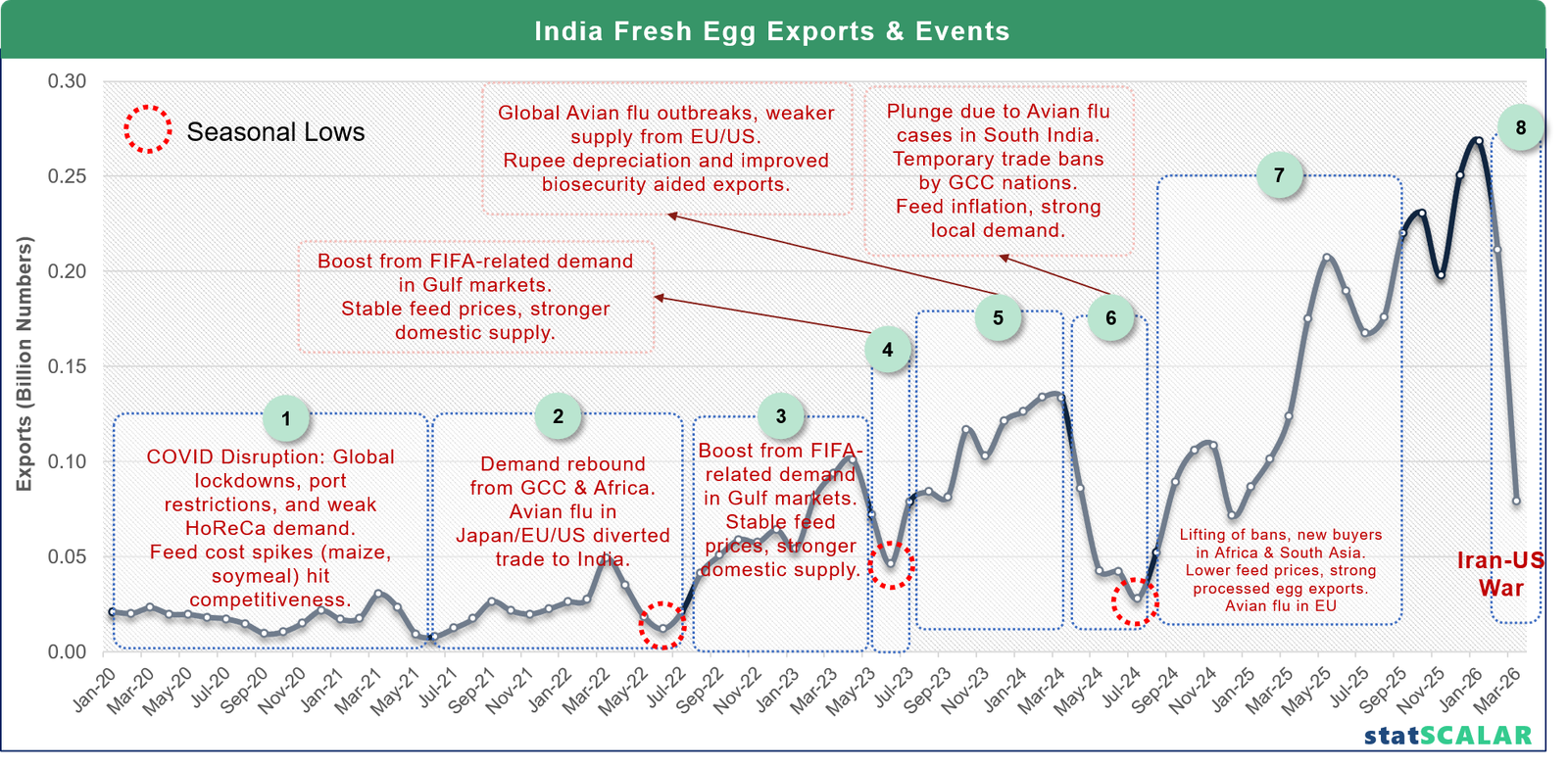
India’s fresh egg export market has experienced significant fluctuations over the past several years, reflecting the combined influence of global health disruptions, avian influenza outbreaks, feed costs, regional demand, trade restrictions and geopolitical developments. The chart, “India Fresh Egg Exports & Events,” tracks export volumes from January 2020 to March 2026 and highlights the major events that contributed to changes in export performance. The long-term trend shows a market that moved from relatively low export volumes during the early pandemic period to substantially higher levels in subsequent years, although sharp corrections occurred during periods of disease outbreaks and trade restrictions.
COVID-19 Disruption Weighed on Early Exports
The first major disruption occurred during 2020–21, when COVID-19-related lockdowns, port restrictions and weaker foodservice and hospitality demand affected international trade. At the same time, higher feed costs, particularly for maize and soybean meal, increased production costs and reduced the competitiveness of Indian egg exports. Export volumes remained relatively subdued during this period, with the chart showing seasonal fluctuations around a comparatively low base.
As international markets began to recover, export demand strengthened. Gulf and African markets contributed to the recovery, while avian influenza outbreaks in Japan and the European Union redirected some international demand toward alternative suppliers, including India. This combination of recovering consumption and changing global supply patterns supported a gradual improvement in export volumes.
Gulf Demand Became an Important Growth Driver
During 2022–23, demand from Gulf markets emerged as a key factor supporting India's fresh egg exports. FIFA-related demand provided an additional boost, while relatively stable feed prices and stronger domestic production helped exporters maintain supply. The chart indicates a clear upward movement in exports during this period, although the market continued to experience short-term volatility.
The strengthening of India's export position was also supported by the country's ability to supply competitive volumes to nearby markets. Geographic proximity to the Middle East, established poultry production capacity and competitive pricing provided Indian suppliers with an advantage when international buyers faced supply disruptions elsewhere.
Avian Flu Created Sharp Export Volatility
One of the most significant turning points occurred around 2023–24, when avian influenza outbreaks affected major producing and consuming regions. The chart identifies global avian flu outbreaks, weaker supply from the European Union and United States, rupee depreciation and improved biosecurity as factors that supported Indian exports.
However, this improvement was followed by a sharp decline associated with avian flu cases in South India and temporary trade bans imposed by GCC countries. Higher feed costs and strong domestic demand added further pressure. This illustrates the sensitivity of India's egg export market to disease-related trade restrictions: even when global supply shortages create an opportunity for Indian exporters, outbreaks within India can quickly restrict market access.
Exports Recovered as Trade Conditions Improved
Following the sharp decline, export volumes recovered as trade restrictions were gradually lifted and international demand improved. The chart highlights new buyers in Africa and South Asia, lower feed prices and stronger processed egg exports as important contributors to the recovery. The diversification of destination markets is particularly significant because it can reduce India's dependence on a limited number of export markets.
The rising export trend through 2024 and 2025 indicates a stronger position for Indian suppliers. Export volumes reached considerably higher levels than those seen during the early part of the period, although the market continued to display pronounced peaks and troughs. Seasonal production patterns, international disease conditions and changes in feed economics remained important drivers of short-term movements.
Geopolitical Risk Adds a New Layer of Uncertainty
The latest section of the chart shows another sharp movement in early 2026, with the chart attributing the event to the Iran–U.S. conflict. Geopolitical disruptions can influence egg exports indirectly through freight costs, regional purchasing patterns, currency movements, feed prices and the availability of alternative suppliers. For Indian exporters, developments affecting the Middle East are particularly important because the region represents an important destination for Indian poultry products.
The latest movement therefore highlights an important characteristic of the Indian egg export market: export performance is influenced not only by domestic poultry fundamentals but also by international events far beyond the farm level.
Key Drivers to Watch in India's Egg Export Market
For exporters, traders and procurement managers, several indicators are particularly important when assessing the outlook for Indian fresh egg exports:
- Avian influenza developments: Disease outbreaks can simultaneously create export opportunities and trigger import restrictions.
- Feed costs: Maize and soybean meal prices directly influence poultry production economics and export competitiveness.
- Gulf market demand: GCC countries remain important destinations, making regional demand and trade policies critical.
- Export destination diversification: Growth in Africa and South Asia could reduce dependence on traditional markets.
- Currency movements: Rupee depreciation can improve export price competitiveness, while appreciation can have the opposite effect.
- Trade restrictions: Temporary bans and sanitary restrictions can cause abrupt changes in export volumes.
- Global supply availability: Shortages in major producing countries can redirect international demand toward India.
- Geopolitical developments: Conflicts and disruptions affecting major trade corridors can influence freight, demand and regional sourcing decisions.
- Seasonality: Egg production and consumption patterns contribute to recurring fluctuations in export volumes.
What the Trend Means for the Market
The six-year trend demonstrates that India's fresh egg export market is becoming increasingly responsive to global market conditions. Export volumes have moved from a relatively low base during the COVID-19 period to significantly higher levels, but the journey has not been linear. Disease outbreaks, feed-cost inflation and trade restrictions have repeatedly produced sharp corrections, while supply shortages in competing countries, Gulf demand and market diversification have created opportunities for Indian exporters.
For businesses involved in poultry trading, procurement and export planning, monitoring export volumes in isolation may not be sufficient. Combining export data with feed prices, avian influenza developments, destination-market demand, currency movements and trade-policy changes provides a more complete view of the market. The StatScalar event-based approach helps connect these external market developments with observable changes in export performance, making the trend more useful for strategic market intelligence and decision-making.
Conclusion
India's fresh egg export market has evolved from a relatively small and volatile export segment into a more globally connected market. The period from 2020 to 2026 demonstrates how quickly export opportunities can emerge when international supply is disrupted, but also how rapidly those gains can reverse when disease outbreaks, trade bans or geopolitical risks emerge. Going forward, market diversification, competitive feed economics, stronger biosecurity and access to reliable international markets will remain central to India's ability to sustain export growth.