India’s biopesticides production industry is entering a new phase of expansion, following a period marked by strong historical growth, pandemic-related disruption, weather-driven demand weakness, and a subsequent recovery. According to statSCALAR’s estimates, domestic biopesticides production is projected to nearly double between 2025 and 2030, supported by increasing adoption of biological crop-protection solutions and improving agricultural demand.
Production Growth Has Followed a Cyclical Pattern
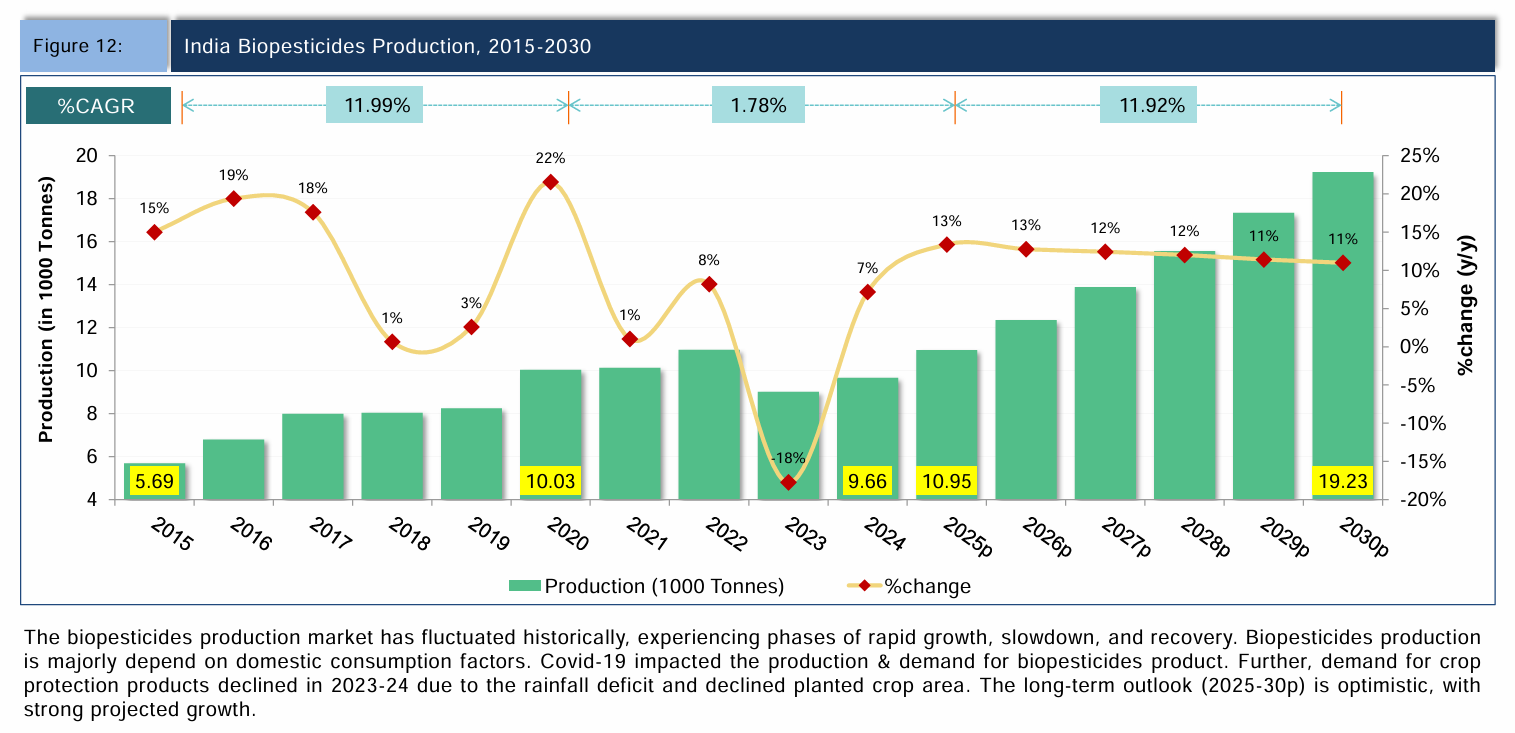
India’s biopesticides production increased substantially during the first half of the historical period. Production rose from 5.69 thousand tonnes in 2015 to 10.03 thousand tonnes in 2020, representing a 11.99% CAGR during 2015–2020.
Growth, however, was not uniform. Production expanded rapidly in 2016 and 2017, with year-on-year growth of 19% and 18%, respectively. Growth subsequently moderated to just 1% in 2018, before recovering to 3% in 2019 and 22% in 2020.
The sharp increase in 2020 occurred against a backdrop of changing agricultural and crop-protection requirements, although the subsequent years demonstrated the vulnerability of the market to broader disruptions.
COVID-19 Created a Period of Volatility
The period following 2020 was significantly more challenging. Production growth slowed to 1% in 2021 and 8% in 2022, before declining by approximately 18% in 2023.
The contraction reflected weaker agricultural demand conditions, including the impact of rainfall deficits and a reduction in planted crop area. Since biopesticides are closely linked to crop cultivation and domestic agricultural consumption, changes in planted area and crop-protection requirements can have a direct impact on production volumes.
Production subsequently recovered to approximately 9.66 thousand tonnes in 2024, representing 7% growth, followed by an estimated 13% increase in 2025, taking production to around 10.95 thousand tonnes.
2025–2030: Growth Momentum Expected to Return
The medium- to long-term outlook is considerably more positive.
According to statSCALAR estimates, India’s biopesticides production is projected to grow at a 11.92% CAGR between 2025 and 2030, reaching approximately 19.23 thousand tonnes by 2030.
This would represent an increase of around 76% from 2025 levels, taking production substantially above the previous peak observed during the historical period.
Why Is the Outlook Positive?
Several structural factors support the expected expansion of India’s biopesticides production.
1. Increasing Focus on Sustainable Agriculture
The shift toward more sustainable agricultural practices is creating greater interest in biological crop-protection products. Biopesticides can complement conventional chemical pesticides and are increasingly considered as part of integrated pest-management strategies.
2. Dependence on Domestic Agricultural Consumption
India’s biopesticides market is strongly influenced by domestic agricultural activity. As cultivated area, cropping intensity and crop-protection requirements recover, demand for biological alternatives is expected to improve as well.
3. Recovery After Weather-Related Weakness
The sharp production decline in 2023 illustrates the sensitivity of the sector to agricultural conditions. A recovery in rainfall and planted crop area can therefore provide an important foundation for renewed demand.
4. Expansion of Biological Crop Protection
Greater awareness among farmers, increasing emphasis on residue management and the broader adoption of integrated pest management are expected to support the penetration of biological products. This creates opportunities for manufacturers to expand production capacity and product portfolios.
Production Growth Could Outpace the Earlier Cycle
One of the most notable features of the outlook is the difference between the two growth phases shown in the chart.
Production expanded at a 11.99% CAGR during 2015–2020, slowed dramatically to just 1.78% during 2020–2025, and is projected to accelerate again to 11.92% during 2025–2030.
This creates a distinctive growth–disruption–recovery pattern:
2015–2020 → Rapid expansion → 11.99% CAGR
2020–2025 → Disruption and slowdown → 1.78% CAGR
2025–2030 → Strong recovery and expansion → 11.92% CAGR
The forecast therefore suggests that the weak growth observed during the first half of the 2020s should not necessarily be interpreted as a structural deterioration in the biopesticides industry. Rather, production appears to be returning to a higher-growth trajectory as agricultural conditions and market demand improve.
What This Means for Biopesticides Manufacturers
The projected increase from 10.95 thousand tonnes in 2025 to 19.23 thousand tonnes in 2030 has important implications for manufacturers, formulators, distributors and agricultural-input companies.
Companies operating in the segment may need to focus on:
- Increasing production capacity to meet projected demand
- Expanding distribution reach across major agricultural regions
- Developing products suited to specific crops and pest profiles
- Strengthening farmer awareness and technical support
- Integrating biopesticides with broader crop-protection programs
- Building reliable supply chains for biological active ingredients and formulations
At the same time, production growth will remain dependent on agricultural conditions. Weather volatility, changes in cultivated area, crop economics and farmer spending on crop-protection products will continue to influence annual demand.
Outlook
India’s biopesticides production sector has demonstrated both strong growth potential and considerable sensitivity to agricultural conditions. After reaching approximately 10.03 thousand tonnes in 2020, production experienced a prolonged slowdown and a sharp contraction in 2023 before recovering in 2024–25.
The outlook is now substantially stronger. statSCALAR projects production to reach 19.23 thousand tonnes by 2030, implying a 11.92% CAGR during 2025–2030.
If this trajectory materializes, India’s biopesticides industry could enter a sustained expansion phase, supported by the growing role of biological crop protection, recovery in agricultural demand and the broader transition toward more sustainable farming practices.
For companies evaluating India’s crop-protection sector, the key takeaway is clear: the next five years could represent a significantly stronger growth phase for biopesticides production than the market experienced during the first half of the 2020s.